All Jharkhand Competitive Exam JSSC, JPSC, Current Affairs, SSC CGL, K-12, NEET-Medical (Botany+Zoology), CSIR-NET(Life Science)

SIMOTI CLASSES

Education Marks Proper Humanity

SIMOTI CLASSES

Education Marks Proper Humanity

SIMOTI CLASSES

Education Marks Proper Humanity

SIMOTI CLASSES

Education Marks Proper Humanity

SIMOTI CLASSES

Education Marks Proper Humanity

Wednesday, September 1, 2021

The Vindhyan System: Geological Structure of India

Vindhyan System

The Vindhyan system derives its name from the Vindhyan Mountain. This mountain forms a dividing line between the Ganga Plain and the Deccan Plateau.The system covers an extensive area of 103,600 km2 from Chittorgarh (Rajasthan) to Sasaram (Bihar).

It has enormous sedimentary deposits and at places, its depth is more than 4000 m. In some tracts. the Vindhyan System from the Aravallis for a distance of about 800 km.

The Vindhyan System is well-known for red sandstone, sandstone, building material, ornamental stone, conglomerates, diamondiferous and raw materials for cement, lime, glass, and chemical industries. In certain places, these rocks yield inferior quality of iron ore and manganese. The well-known diamond mines of Panna and Golconda lie in the Vindhyan system.

The Vindhyan System: Geological Structure of India

 
The historical buildings of Qutab Minar, Humayun's Tomb, Fatehpur Sikri, Agra Fort, Jama-Masjid, Birla Mandir, the Buddhist Stupa of Sanchi, etc., have been constructed from the red sandstone obtained from the Vindhyan Ranges. Coarser sandstones have been used as grindstones and millstones.

Name of the series of Vindhyan System

Distribution in India

Significant Features

Bhander Series

1. Western part of Vindhyan formation. 

1. Main rocks: sandstone, shales, limestones.

2. It provides good building material.

Bijwar Series

1. Stretches over districts of Chhatarpur and Panna in Madhya Pradesh.

1. Main rocks: sandstone, red sandstone, quartzite.

2. Basaltic intrusions found whose dykes are rich in diamonds.

Kaimur Series

1. Stretches over Bundelkhand (UP), Baghelkhand (MP).

1. Main rocks: sandstone, conglomerate, shale.

2. Red sandstone was used in historical monuments like Red Fort, Hawa Mahal, Qutub Minar, Humayun's Tomb.


Share:

The Indian Islands: Physiography of India

The Indian Islands

India has a total of 650 Islands, of which 572 lie in the Bay of Bengal, and the remaining 43 in the Arabian Sea. Out of the 572 islands of Andaman and Nicobar, only 36 are inhabited. The Bay of Bengal islands includes the Andaman and Nicobar Islands which are largely tectonic and volcanic in origin, while the Island of the Arabian Sea is mainly coral formations.

Moreover, there are several offshore islands along with the mouth of the Ganga, eastern and western coasts, and in the Gulf of Khambat, Kachchh, and Mannar.

The Indian Islands: Physiography of India

Island of the Bay of Bengal:

  • The Andaman and Nicobar islands are separated by the Ten Degree Channel.
  • The shortest distance of the Andaman Islands from the mainland (Bay of Bengal Head) is about 2000 km and the extreme southern point is the Indira Point- the southernmost point of the Great Nicobar Island.
  • The Andaman and Nicobar Islands have a warm tropical climate all year round with two monsoons. Temperatures are around 25°C, but the sea breeze has a cooling effect.

The Andaman and Nicobar Islands are thickly forested and have rich marine life among the reefs. The islands are a birdwatcher's paradise with 242 species recorded. The entire region falls in a major earthquake zone. The Barren Island in the Andamans has an active volcano.

In the Bay of Bengal, there are two (2) volcanic islands (Barren and Narcondam) situated within 80 km east of the Andaman Islands. The Andaman Islands have been formed by the extension of the Tertiary mountain chain of Arakanyoma. The main rock of these islands is sandstone, limestone, and shale. 

The Nicobar group of islands comprise 18 islands of which only 11 are inhabited. The physiography of the Nicobar Islands is mainly of the coral region.

Crop & Cultivation:

  • Rice is the main crop in Andaman and Nicobar Islands. 
  • Tropical fruits like pineapple, a variety of bananas, sweet papaya, and mango grow on a smaller scale in the Andaman group of islands.

People: 

The Tribal population in the Andaman Islands is fast dwindling. Most of its present inhabitants are migrants from Bangladesh, Myanmar, and India, and Tamils from Sri Lanka. Some of the well-known surviving tribes of the Andamans and Nicobar are the Onges, Jarawas, and Sentinelese.

Fauna: 

One of the largest and also the rarest crabs in the world, the Giant Robber Crab, can be found in the Wandoor Marine Biosphere Reserve in south Andaman and Great Nicobar Islands. Its powerful claws help it to climb the coconut tree and break the hard shell of its fruit.


The Arabian Sea Islands:

  • There are 43 islands in the Arabian Sea, out of which only 11 are inhabited. The shortest distance from the mainland (Calicut) is about 109 km.
  • Karavatti, located on the island of this name is the capital of Lakshadweep. Lakshadweep islands are separated from the Maldives Islands by the Eight Degree Channel. Hills and streams are absent on these islands.
  • The Minicoy is the largest (4.5 km2) and has a lighthouse and a weather observatory.
  • In Lakshadweep coconut is the only major crop, although pulses and vegetables are also grown.
  • The sea around the island is rich in marine life.

Offshore Islands:

There are numerous islands in the delta region of Ganga and in the Gulf of Mannar. Among the Western coast of Piram, Bhaisala (Kathiawar), Diu, Vaida, Nora, Pirotan, Karunbhar (Kachchh coast), Khadiabet, Aliabet (Narmada-Tapi mouths), Butchers, Elephanta, Karanja, Cross (near Mumbai), Bhatkal, Pegioncock, St. Mary (Mangalore coast), Anjidiv (Goa coast), Vypin near Kochi, Pamban, Crocodile, Adunda (Gulf of Mannar), Sri Harikota (mouth of Pulicat lake), Pairkud (mouth of Chilka lake), short, wheeler (Mahanadi-Brahmani mouth), and New Moore, and Ganga-Sagar and Sagar (Ganga Delta). Many of these islands are uninhabited and administered by the adjacent states.

Previous Page:The Indian Deserts: Physiography of India

Next Page:The Vindhyan System: Geological Structure of India

Share:

The Indian Deserts: Physiography of India

The Indian Deserts

A desert is an arid land where the water is lost through evaporation than is gained from precipitation. It is the region where the rate of evaporation is higher so that of the rate of precipitation. 

The Indian subcontinent has the following deserts:

1. The Thar Desert:

It is a low-latitude desert and is known as a tropical desert. The name Thar is derived from 'thul' a term is used for the region's sand ridges. 

  • The Thar desert is a largely arid region that covers an area of 200,000 km2
  • It is the ninth (9th) largest subtropical desert in the world.
  • It is broader by plains of the Indus River to the west (W), Punjab plain to the north (N) and northeast (NE), Aravali range to the southeast (SE), and Rann of Kutch to the south (S).
  • More than 60% of the desert lies in Rajasthan.
The Indian Deserts: Physiography of India

The land surface of the That Desert is wind deposited (Aeolian) accumulation of sand over the past 1.8 million years. Its surface has high and low sand dunes separated by sandy plains and low barren hills (bhakars). The dunes are in continual motion and keep varying in their shapes and sizes. Some of the older sand dunes are 150 m in height. 

The region has playas (saline lake beds), locally known as dhands, scattered throughout the region. E.g. The Sambhar, Kuchman, Didwana, Pachpadra, Phalodi (Rajasthan), Kharagoda (Gujarat), Lunkaransar are major sources of the common salt.

Climate:

  • The Thar Desert receives low annual rainfall, of about 4 inches (in the west) to 20 inches (in the east). 
  • The winds are dry northeast monsoon and the deserts record temperature up to 50°C in May and June. 
  • The coldest month is January with a minimum temperature of 5-10°C. The winters are short and for two (2) months only in December and January. 

Flora:

  • It includes stunted scrub, drought-resistant trees, gums Arabica, acacia, jojoba, Khejri tree, and Euphorbia.
  • Khejri is an indigenous tree that plays a vital role in stabilizing the sand dunes. It can also withstand periodic burial under the sand dunes. 

Fauna:

  • It includes falcon, kestrel, blackbucks, chinkara, Indian wild ass, foxes, partridges, quail, vultures, and reptiles.

Water Resources and National Parks:

  • The river Luni, originating from the Pushkar valley of the Aravalli Range is the only natural water resource that reaches the Arabian Sea through the Run of Katchchh.
  • Indira Gandhi Canal is the source of fresh water and irrigated the vast expanse of the Indian portion of the Thar Desert.
  • The Desert National Park is an important ecosystem. 
  • The Tal Chhapar Sanctuary is an important bird reserve area located in Churu district and also an abode of a large population of blackbuck, fox, caracal, and sandgrouse.
  • The Keoladeo Ghana National park (Desert National Park, Jaisalmer) has fossils of tree trunks and seashells.

The Thar Desert has a population density of 83 people per km2and it is the most densely populated desert in the world. It has become the largest wool-producing area in India. Animal husbandry has increased as the harsh climatic conditions and the land terrain do not favor farming. However, Kharif crops are the main agricultural production. Bajra is the main crop. The solar energy and wind energy of the region are being exploited to generate electricity.

Previous Page: Fossil Parks: Geological Structure of India

Next Page:The Indian Islands: Physiography of India

Share:

Fossil Parks: Geological Structure of India

Fossil Parks

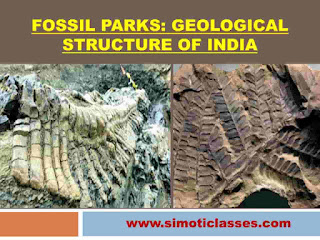
Fossil Parks are important as they provide information about the diversity and the evolution of life through time. They help in preserving the fossils and spread awareness to the public about the values of fossils. The protected areas are maintained by the Geological Survey of India, to preserve the rocks, minerals, fossils, and meteorites.


Fossil Parks: Geological Structure of India


1. Shivalik Fossil Park (Saketi, Sirmaur district, Himachal Pradesh):

  • It has size models of vertebrates that might have inhabited Shivalik Hills, about 1.5 to 2.5 million years ago.
  • It covers an area of about 1.5 km2 in the Markanda valley of Sirmaur. This park was built to put a check on the destruction of fossil bones. This site has been developed to a panorama of the Pilo-Pleistocene period (2.5 million years) through large afforestation.

2.  Mandla Plant Fossils National Parks (Dindori, Madhya Pradesh):

  • This national park preserves the fossil remains of primordial forest about 40-150 million years ago.
  • The total area of the park is o.25 km2 which is spread over seven (7) villages of Dindori district namely- Ghuguwa, Umaria, Deorakhurd, Barbaspur, Chanti Hills, Chargaon, and Deori Kohani.

3. Ghughua Fossil Parks (Madhya Pradesh):

  • The national park has a trove of plant fossils belonging to 31 genera of 18 plant families.
  • The fossils indicate life in the area about 65 million years ago.

4. Marine Gondwana Fossil Park, Manendragarh, Sarguja district, Chattisgarh

  • It has fossiliferous marine Permian rocks of Talchir formation dated 280-240 million years.
  • It has a spread of 1 km on the right bank of the Hasdeo river and Hashia Nala.

5. National Fossil Wood Park, Tiruvakkarai, Tamil Nadu

  • It has 200 fossil trees ranging in length from 3-15 m and up to 5 m in girth which are seen as lying horizontally embedded in the Cuddalore Sandstone of the Mio-Pliocene age about 20 million years ago. 
  • It covers an area of 1 Km2.
  • The longest specimen measures 13.4 m X 0.9 m. 
  • Scientists believe that these trees did not grow at that site but were transported there before they were permitted.

6. National Fossil Wood Park, Santhanur, Tamil Nadu

  • This wood park contains large trunks of petrified trees (conifers) of the Upper Cretaceous age (100 million years ago).
  • The fossilized tree trunk at Sathanaur measures over 18 m in length.

7. Akal Wood Fossil Park, Jaisalmer district, Rajasthan

  • The fossil of the wood found in this park reflects the warm and humid climate considering the sea some 180 million years ago.
  • It contains fossils of wooden logs (petrophyllum, ptyllophyllum, equisetitis species, and dicotyledonous wood and gastropod shells of the Lower Jurassic period) lying in random horizontal orientation.

8. Stromatolite Park, Bhojunda, Chittaurgarh, Rajasthan

  • Stromatolites are structures produced by blue-green algae. 
  • They are the result of the combination of life activity and sediment trapping ability of algae and the preying bacteria.
  • Their formation occurs in shallow water where the tides bring the floating sedimentary material and make it flow through carbonate particles. These are the impressions of the earliest life forms.

9. Stromatolite Park, Jharkhand, and Udaipur district, Rajasthan

  • It is the largest and rich in deposits of phosphorite.
  • This site preserves and provides shreds of evidence of early life on the earth.
  • The rocks phosphate occurs in dolomite limestone associated with stromatolites which have a bluish-grey appearance.

Statewise details of the geological heritage sites/ national geological monuments declared by the Geological Survey of India are given in the following table:

State

Geological Heritage Sites/ National Geological Monuments 

Andhra Pradesh 

Mangampeta, Cuddapah district, Chittor district, National geological arch, Tirumala hills, Erra Matti Dibbalu-Stable coastal red sediments, Vishakhapatnam, Bheemunipatnam.

Kerala 

Laterite near Angadipuram, Malappuram district, Varkala Cliff Section, Thiruvanathapuram district. 

Tamil Nadu 

Fossil wood near Tiruvakkarai, South Arcot district, National Fossil wood park, Sathanur, Perambalur district, Charnockite, St. Thomas Mount, Madras, Badlands of Karai formation with cretaceous fossils along with Karai, Perambalur district. 

Gujarat 

Sedimentary structures- Eddy Markings, Kadam Dam, Panchmahal district. 

Rajasthan

Sendra granite, Pali district, Stromatolite Park, Bhojunda, Chittorgarh district, Rajasthan, Akal wood fossil park, Jaisalmer district, Kishangarh Nepheline Syenite, Ajmer district, Welded Tuff, Jodhpur district, Malani Igneous Suite Contact, Jodhpur district, Great Boundary Fault at Sutar, Bundi district.

Maharashtra 

Lonar lake, Buldhana district. 

Chattisgarh

Lower Permian Marine bed, Manendragrah, Sarguja district.

Karnataka

Columnar Lava, St. Mary's island Udupi district, Peninsular Gneiss, Lalbagh, Bangalore, Pyroclastics and pillow lavas, Kolar Goldfields, Kolar district.

Himachal Pradesh

Siwalik Fossil Park, Saketi, Sirmaur.

Odisha 

Pillow lava in Iron ore belt at Nomira, Keonjhra district. 

Jharkhand

Plant fossil-bearing inter-trappean beds of Rajmahal formation, upper Gondwana sequence around Mandro, Sahibganj district.  

Nagaland 

Nagahill Ophiolite site near Pungro. 

Sikkim 

Stromatolite bearing Dolomite/Limestone of Buxa formation at Mamley near Namchi, South district. 

Source: Ministry of Mines, Government of India, 2016


Share:

Tuesday, August 31, 2021

The Coastal Plains: Physiography of India

The Coastal Plains

The Peninsular Plateau of India is flanked by narrow coastal plains of varied width from north to south, known as the West-Coastal Plains and the East-Coastal Plains. These coastal plains differ from each other. They were formed by the depositional action of the rivers and the erosional and depositional actions of the sea waves.

According to geologists, the origin of the western and eastern coasts of India may be attributed to the faulting and subsidence of the Arabian Sea and the Bay of Bengal towards the close of the Eocene Period. Considering, the alluvial deposits along these coasts are of very recent origin, ranging from Pliocene to recent times. These coastal plains have evidence of submergence and emergence.

The Coastal Plains: Physiography of India

The Indian coastal plains may be subdivided into the following three (3) divisions;

1. The Gujarat Coastal Plains:

  • The Gujarat plain covers almost the entire state of Gujarat, except the district of Banaskantha and Sabarkantha.
  • It is formed by the alluvial deposits of Sabarmati, Mahi, Luni, and numerous tiny parallel consequent streams.
  • It contains the Gondwana rocks (Umia series), resting over the marine Jurassic rock and capped by Lower Cretaceous (Aptian) beds. The Deccan lava lies over the Umia series.

The eastern section of Gujarat Plain is a projected jet of the Sindhu-Ganga alluvial tract in Peninsular India. This projection is the outcome of extensive Pleistocene sedimentation. Present rivers have further advanced this deposition to the Gulf of Khambat. 

Among the highlands, mention may be made of;

  • Rajpipla Hills (Satpura)-famous for agate quarries
  • Parnera Hills in Bulsar district
  • Sahyadris in the southern side and 
  • Igneous complex of the Girnar Hills (Gorakhnath Peak, 1117 m)
  • Mandav Hills in Kathiwad.

The Rann of Katch is an extensive tact of naked tidal mudflats transected by abandoned and live creeks. The Gulf of Katch separates the Rann of Katch from the Kathiawar Peninsula. The salt in the soil makes this low-lying marshy area almost barren and unproductive. The whitish vertebrae of salts appear as white bony structures of the dried creeks. Live creeks from the dendritic pattern of drainage and there has been accentuation in this pattern due to earthquakes. South of the Rann lies Katch, formerly an island, which is almost surrounded by the Rann except in the south-west.


2. The West Coastal Plains:

  • It lies between the Sahyadris and the Arabian Sea. It is about 1400 km long and 10-80 km wide. 
  • It has an elevation up to 150 m above sea level, reaching more than 300 m at places.
  • The western coastal plain is characterized mainly by sandy beaches, coastal sand-dunes, mud-flats, lagoons, alluvial tracts along rivers, estuary, laterite platforms, and residual hills.
  • The Sahyadris (elevation 750-1225 m) runs parallel to the plain and present their steep face to the low lands with Thalghaat and Borghat (gaps) in the north and the Palghat (Palakkad gap) in the south of the Nilgiri.
  • Southwards is the Karnataka coastal plain which is about 525 km long and 8-25 km wide. It is the narrowest part of the west coastal plain. 
  • The southern part is known as the Malabar coast is found in the valleys of Beypore, the Ponnani (draining through Palghat), the Periyar, and Pamba Achankovil rivers. The coast is characterized by sand dunes. 

Along the coast, there are numerous shallow lagoons and backwaters- Kayaks and Teris. These lagoons are linked together to facilitate navigation through small boats. Here, Vembanad and Asthamudi are important lagoons of the Malabar coast. It is the homeland of aquatic life like crabs, frogs, mudskippers, birds like terns, kingfishers, cormorants, and otters and turtles live alongside the backwaters. 

The backwaters are important tourist spots and are of importance for transportation, fishing, and even agriculture. The region has deposits of Monazite sands which are reddish-brown and rich in phosphate. Monazite is radioactive due to the presence of thorium.


3. The East Coastal Plains: 

  • The eastern coastal plain lies between the Eastern Ghats and the Bay of Bengal and stretches along the coasts of Odisha, Andhra Pradesh, and Tamil Nadu. 
  • These plains are formed by the alluvial fillings of the littoral zone comprising some of the largest deltas of the world.
  • The east-coast plain consists mainly of recent and tertiary alluvial deposits. These are gentle, monotonous plains rinsing gently westward to the foot of the Eastern Ghats. The monotony of the topography is broken by the presence of numerous hills. 
  • This coastal plain has a straight shoreline with well-defined beaches of sand shingles. The most famous is Marina Beach (Chennai). 

There are some of the important lagoons of India along the Eastern coast, of which, Chilka lake in the southwest of the Mahanadi delta is the biggest lake (area= 65 km X 8 km) in the country. The Kulleru lake lies between the deltas of Godavari and Krishna while the Pulicat lake lies further south on the border of Andhra Pradesh and Tamil Nadu.

Previous Page:Forest Conservation: Geography- JPSC/ JSSC

Next Page:Fossil Parks: Geological Structure of India

Share:

Chotanagpur Kashtkari Adhiniyam 1908 Part-5 (छोटानागपुर काश्तकारी अधिनियम 1908)

Chotanagpur Kashtkari Adhiniyam 1908 Part-5

अध्याय 10 :- भू-स्वामी तथाा काश्तकार केे लिए प्रकीर्ण उपबंध (कोड़कर) (धारा- 64 से 75)

➧ धारा - 64 :- उपायुक्त के आदेश से भूमि के कोड़कर में परिवर्तन

➧ किसी गांव के कृषक या भूमिहीन श्रमिक उपायुक्त की पूर्व अनुमति लेकर सामान्य भूमि को कोड़कर भूमि में बदल सकते हैं
 सामान्यत परती या टांड़ भूमि को रैयत कोड़कर समतल बनाते हैं तथा इस पर धान की खेती करते हैं इस प्रकार से तैयार किया गया खेत शुरू में लगान मुक्त होता है , परंतुु बाद में इस पर उपयुक्त लगान का निर्धारण  कियाा जाता है , लेकिन यह सामान्य लगान दर से हमेशा कम होताा है


➧ धारा - 65  :- कृषक को बेदखल करने या कब्जा बनाये रहने देने की शक्ति

 छोटानागपुर काश्तकारी, 1947 के द्वारा धारा-21 के तहत यह प्रावधान समाप्त कर दिया गया है

➧ धारा - 66  :- कतिपय भूमि को कोड़कर में परिवर्तित करने का प्रतिषेघ (रोक)


 धारा - 67  :- कोड़कर  में अधिभोगाधिकार

 ऐसे रैयत, जो किसी भूमि का जोत धारण करता हो और उसके परिवार के किसी सदस्य ने उस भूमि को कोड़कर में परिवर्तित कर दिया हो, लेकिन वह 12 वर्ष तक उस भूमि पर खेती नहीं किया हो, तो प्रथम व्यक्ति का भूमि पर अधिभोगाधिकार बना रहेगा

➧ धारा - 67 (क) :- कोड़कर  में समपरिवर्तित भूमि के लगान का निर्धारण

➧ अगर कोई व्यक्ति भूमि को कोड़कर में बदला हो तो उस भूमि पर प्रथम कृषि वर्ष की फसल कटाई से 4 वर्ष तक कोई लगान का निर्धारण नहीं किया जाएगा। 4 वर्ष के पश्चात कोड़कर भूमि पर लगान का निर्धारण किया जाएगा, लेकिन वह लगान की  दर गांव के तृतीय वर्ग की धनहर भूमि के लिए प्रचलित दर के आधे से अधिक नहीं होगी।

➧ धारा - 68  :- काश्तकार को बेदखल किया जाना

➧ किसी भी काश्तकार को किसी डिक्री या उपायुक्त के आदेश के सिवाय किसी दूसरे तरीके से उसे जमीन से बेदखल नहीं किया जा सकता है। 

➧ धारा - 69  :- काश्तकार को  राहत पाने का अधिकार

➧ किसी अधिभोगी रैयत ने भूमि का उपयोग रूढ़ि और रीति के अनुसार किया हो और उसके कार्य के कारण भूमि के मूल्य में कोई गिरावट नहीं आया हो तथा भूस्वामी और काश्तकार के बीच हुए संविदा की शर्तों को नहीं तोड़ा हो, तो अधिभोगी रैयत राहत पाने का अधिकारी है

➧ धारा - 70  :- वेदखली का डिक्री या आदेश कब प्रभावी होगा

➧ इस अधिनियम में अधीन पारित आदेश उस कृषि वर्ष के अंत से या ऐसे पूर्ववर्ती तारीख जिसे न्यायालय निर्देशित करें, उसी के अनुसार प्रभावी होगा।


➧ धारा-71(क) :- विधिविरुद्ध अंतरिम भूमि पर अनुसूचित जनजातियों के सदस्य को कब्जा प्रत्यावर्तित करने की शक्ति उपायुक्त में अंतर्निहित रहेगी। 

➧ इस संदर्भ में निम्न विधान है:-

(i) यदि उपायुक्त को यह ज्ञात हो कि कोई व्यक्ति धारा-46 के नियम उल्लंघन कर अनुसूचित जनजाति के रैयत की जमीन कपट या छल पूर्वक प्राप्त किया है।  
➧ तो वह अंतरिति (क्रेता) सफाई देने का अवसर देगा। इसके पश्चात दोषी पाए जाने पर अंतरिति को बिना कोई रकम लौटाई ही उसका जमीन अनुसूचित जनजाति के सदस्य को वापस कर देगा। 

(ii) अंतरक  अर्थात विक्रेता का अगर कोई वारिस बारिश नहीं हो, तो वैसा स्थिति में स्थानीय नियम अनुसार किसी दूसरे अनुसूचित जनजाति के रैयत को उपायुक्त जमीन का पुर्नबंदोबस्त कर देगा। 

(iii) अगर अंतरित (क्रेता) के अंतरण (हस्तांतरण) के तारीख के 30 वर्ष के भीतर उपायुक्त को यह जानकारी मिलती हो, कि अंतरीति ने अनुसूचित जनजाति के सदस्य से प्राप्त जोत पर भवन निर्माण कर लिया हो और अंतरक (विक्रेता) उसका मूल्य चुकाने में रजामंद न हो तो ऐसे में उपायुक्त अंतरिति अर्थात क्रेता के 2 वर्ष के भीतर भवन हटाने का आदेश देगा, अगर क्रेता द्वारा भवन नहीं हटाया गया, तो उपायुक्त खुद हटाएगा। 


(v) यदि उपायुक्त जांच के उपरांत यह पाए कि अंतरिति (क्रेता) ने बिहार अनुसूचित क्षेत्र विनिमय 1969 कानून लागू होने के पहले ही किसी भूमि पर भवन का निर्माण कर लिया है, तो ऐसे में उपायुक्त अर्थात क्रेता को यह आदेश देगा, कि वह अंतर अर्थात विक्रेता को पुनर्वास के लिए समतुल्य भूमि उपलब्ध कराएं।

➧ साथ ही उपायुक्त द्वारा निर्धारित पुनर्वास राशि अंतरक को प्रदान करें। ऐसा करने पर अंतरिति को जमीन से जुड़े अधिकार की मान्यता उपायुक्त दे देगा। 

(vi) जाँच उपरांत अगर उपायुक्त को यह पता चले की अंतरिति अर्थात क्रेता ने कब्ज़ा द्वारा प्राप्त भूमि पर अपना हक़ अर्जित किया है तथा अंतरिती  अर्थात प्राप्त भूमि को लेने के लिए अंतरक तैयार नहीं है। तो ऐसी स्थिति में उपायुक्त उपयुक्त प्रति कर का निर्धारण कर सकता है।  

(vii) इस धारा के तहत आदिवासी जमीनों की पुनर्वापसी के लिए एक विशेष अदातलायी व्यवस्था अनुसूचित क्षेत्र विनिमय न्यायालय (SAR- Scheduled Area Regulation Court) कोर्ट की स्थापना की गई है 

➧ धारा-71(ख) :-  यदि कपट पूर्ण तरीके से कोई भूमि अंतरिति (विक्रय) की जाए, तो जांच उपरांत कपट करने वाले को दंड स्वरूप 3 वर्ष की सजा अथवा ₹1000 जुर्माना या दोनों लगेगा। अपराध जारी रहने की दशा में अपराध की अवधि तक अंतरिती अर्थात (क्रेता) को प्रत्येक दिन अधिकतम ₹50 अतिरिक्त जुर्माना देना होगा।

➧ धारा-72 :-  रैयत द्वारा भूमि का अभ्यर्पण (Slender)

 यदि कोई रैयत किसी करार से न जुड़ा हुआ हो तो वह किसी वर्ष के अंत में उपायुक्त की पूर्व मंजूरी लेकर अपने जोत को सैरेंडर कर सकता है, परंतु इसकी सूचना रैयत द्वारा भूस्वामी को सरेंडर के 4 माह पूर्व देना होगा। यदि वह ऐसे सूचना नहीं देता है, तो सरेंडर के पश्चात अगले कृषि वर्ष के लिए जोत भूमि का लगान का भुगतान भूस्वामी को करना ही होगा।

➧ धारा-73 :-  रैयत द्वारा भूमि का परित्याग

 यदि कोई रैयत भूमि का परित्याग स्वेच्छा से कर दे और लगान देना बंद कर दे तो उसकी भूमि को भूस्वामी किसी दूसरे को पट्टे में दे सकता है 

➧ कोई अधिभोगी रैयत 3 वर्ष के भीतर एवं अनाधिभोगी रैयत 1 वर्ष के भीतर उपरोक्त भूमि पर कब्जा वापस लेने का आवेदन उपायुक्त को दे, और उपायुक्त जांच उपरांत यह पाए के रैयत ने स्वेच्छा से भूमि का परित्याग नहीं किया था, तो वैसी स्थिति में रैयत द्वारा बकाया लगान के भुगतान करने के बाद रैयत को भूमि पर पुन: कब्जा दिलाने का आदेश दे सकता है। 

➧ धारा-74 :- किसी रैयत के अधिभोग का जारी रहना पट्टे की स्थिति पर निर्भर करता है 

➧ धारा-75 :- भूमि का माप

 प्रत्येक भूस्वामी को अपने क्षेत्राधीन भूमि का माप करने का अधिकार होगा। या इससे जुड़े दूसरे संपदा का भी वे सर्वेक्षण कर सकेगा। अधिभोगी रैयत सर्वेक्षण या माप का विरोध करें। तो भू-स्वामी उपायुक्त को आवेदन देकर इस संदर्भ में उचित दिशा-निर्देश प्राप्त कर सकेगा।

अध्याय -11 :-रुढ़ि और संविदा (धारा- 76 से 79)

➧ धारा-76   रूढ़ि की व्यावृति :-  रूढ़ि एवं प्रथा किसी अधिकार को प्रभावित नहीं करेगी। 

➧ धारा-77  सेवा भू धृतियों तथा जोतों के विषय में व्यावृति :- भू -धृति या जोत का प्रभाव अधिकार पर नहीं पड़ेगा। 

➧ धारा-78  वासभूमि:-


 धारा-79 :- अधिनियम के अपवर्जन का करार द्वारा प्रतिबंध

 इस अधिनियम के लागू होने के पूर्व या पश्चात कोई भूस्वामी किसी रैयत के साथ संविदा के माध्यम से कोई अधिभोगाधिकार को वर्जित नहीं करेगा और ना ही हटाएगा।

अध्याय-12 :-अधिकार अभिलेख और लगान का निर्धारण (धारा- 80 से 100(क)

➧ धारा-80 :- सर्वेक्षण करने और अधिकार-अभिलेख तैयार करने का आदेश देने की शक्ति

➧ राज्य सरकार राज्य सरकार किसी राज्य स्वराज अधिकारी द्वारा किसी स्थानीय क्षेत्र, भू-धृति या संपदा का सर्वे कराने या उससे जुड़े अधिकार अभिलेख कराने का आदेश दे सकती है

➧ धारा-81  :- अभिलिखित की जाने वाले विशिष्टयां 

 धारा-80 के आदेश अनुसार जो अधिकार अभिलेख तैयार होगा उसमें काश्तकार का नाम, भूमि की सीमा, उसका वर्ग, भूमि की सीमा, भू-स्वामी का नाम, भुगतान होने वाला लगान , लगान निर्धारण की प्रक्रिया जैसे शर्ते वर्णित होगी।

 धारा-82 :- जल के विषय में सर्वेक्षण करने तथा अधिकार-अभिलेख तैयार करने का आदेश देने की शक्ति

 राज्य सरकार किसी ऐसे राजस्व अधिकारी को आदेश निर्गत कर सकती है, जो भू -स्वामी या काश्तकारों के बीच जल के उपयोग एवं उसके बहाव से संबंधित विवाद का निपटारा कर सकें।

➧ धारा-83 :-अधिकार-अभिलेख का प्रारंभिक प्रकाशन, संशोधन और अंतिम प्रकाशन।

➧ धारा-84 :-अधिकार-अभिलेख के अंतिम प्रकाशन और उसकी शुद्धता के बारे उपधारणाएँ।

➧ धारा-85 :- उचित लगान का परिनिर्धारण


 धारा-86 :- लगान परिनिर्धारण में अगर किसी प्रकार का विवाद हो तो ऐसे में राजस्व अधिकारी नए सिरे से तैयार किए गए अधिकार अभिलेख पर विचार करते हुए, धारा 85 के तहत लगान का परिनिर्धारण कर सकेगा।

➧ धारा-87 :-राजस्व अधिकारी के समक्ष संस्थित किया जाना

➧ अधिकार अभिलेख के अंतिम प्रकाशन हो जाने के बाद अगर अलग-अलग पक्षों के बीच कोई विवाद हो तो इसे राजस्व अधिकारी के समक्ष रखा जा सकता है । ऐसे में राजस्व अधिकारी इस वाद/मामले को किसी सक्षम  न्यायालय में सुनवाई हेतु भेज सकता है

➧ धारा-87(क)  :- कतिपय कार्यवाहियो और वादों में उपरैयत को भी पक्षकार बनाया जाना 

➧ धारा-88  :-अगर लगाने या उससे जुड़े किसी दूसरे मामलों पर नए फैसले आते हैं, तो उससे अधिकार अभिलेख में प्रविष्टि किया जायेगा। 


 राज्य सरकार द्वारा नामित राजस्व अधिकारी आवेदन मिलने पर या फिर स्वप्रेरणा से अधिकार अभिलेख के प्रारूप में की गई किसी भी प्रवृष्टि या आदेश को चाहे तो 12 महीने के भीतर पुनरीक्षण कर सकता है

➧ धारा-90  :-अधिकार-अभिलेख की भूलों की राजस्व अधिकारी द्वारा शुद्धि किया जाएगा 

 धारा-91 :-अधिकार-अभिलेख के आदेश को रोका जाना 

 अधिकार अभिलेख की तैयारी के किसी आदेश को अधिकार अभिलेख के अंतिम प्रकाशन के पश्चात् छः माह तक उपायुक्त या सिविल न्यायालय द्वारा रोका नहीं जा सकेगा। 

➧ धारा-92  :-अधिकार-अभिलेख संबंधी विषयों  में न्यायालयों की अधिकारिता का वर्जन 

 अधिकार अभिलेख की तैयारी से जुड़े कोई भी वाद/मुकदमा किसी भी न्यायालय में नहीं लाया जा सकता।
 
 धारा-93  :-अधिकार-अभिलेख के अंतिम प्रकाशन तक उपायुक्त या सिविल न्यायालय के समक्ष कतिपय कार्यवाहियों पर रोक

 अधिकार अभिलेख के अंतिम प्रकाशन से छः महीने तक सम्बंधित भूमि या उसके किसी कस्तकार को प्रभावित करने से जुड़ा कोई आवेदन न तो सिविल न्यायालय में दायर किया जाएगा और न ही उपायुक्त के समक्ष प्रस्तुत किया जाएगा।

➧ धारा-94  :- जिस कालावधि के लिए अधिकार-अभिलेख में लगान दर्ज किया हो वह अपरिवर्तित रहेगा।

➧ धारा-95 :- इस अध्याय के अधीन कार्यवाहियों के खर्च-अधिकार अभिलेख की तैयारी एवं संपूर्ण प्रक्रिया में खर्च अधिभोगियों के द्वारा चुकाया जाएगा। 


➧ धारा-97 :- वह तारीख, जब से परिनिर्धारित लगान प्रभावी होगा।

➧ नियमानुसार परिनिर्धारित लगान अगले कृषि वर्ष के प्रारंभ से लागू होगा। 

➧ धारा-98  :-राज्य सरकार के आदेशाधीन अधिकार-राज्य सरकार चाहे तो, अपने आदेश के जरिए अभिलेख का पुनरीक्षण एवं  लगान का नया परिनिर्धारण का आदेश जारी कर सकता है।  

➧ धारा-99 :-लगान में वृद्धि


➧ धारा-100 :- इस अधिनियम के प्रारंभ के पूर्व कतिपय अधिकारियों के अभिलेख के लिए दिए गए निर्देशों का विधिमान्यकरण।

➧ इस  अधिनियम के पूर्व बंगाल काशतकारी अधिनियम, 1885 की धारा-101 के अंतर्गत, यदि इस अधिनियम धारा-81 के उपखण्ड (ढ )में अधिकार को अभिलिखित किया जाये, तो विधिमान्य होगा।  

➧ धारा-100(क)  :-चराई,वन-उपज लेने आदि के अधिकारों एवं तत्त्संबंधी भुगतान के सम्बन्ध में कतिपय उपबंधों का लागु होना

➧ चराई, वन-उपज लेने, मत्स्य पालन आदि अधिकार उस व्यक्ति का होगा जो भूमि धारण करता हो। 

Share:

Unordered List

Search This Blog

Powered by Blogger.

About Me

My photo
Education marks proper humanity.

Text Widget

Featured Posts

Popular Posts